Being Independent in 2026
It's not the frame that makes the shop. An interview with Dante Caretti at MIDO, exploring entrepreneurial identity, research, and positioning in the independent optics market.
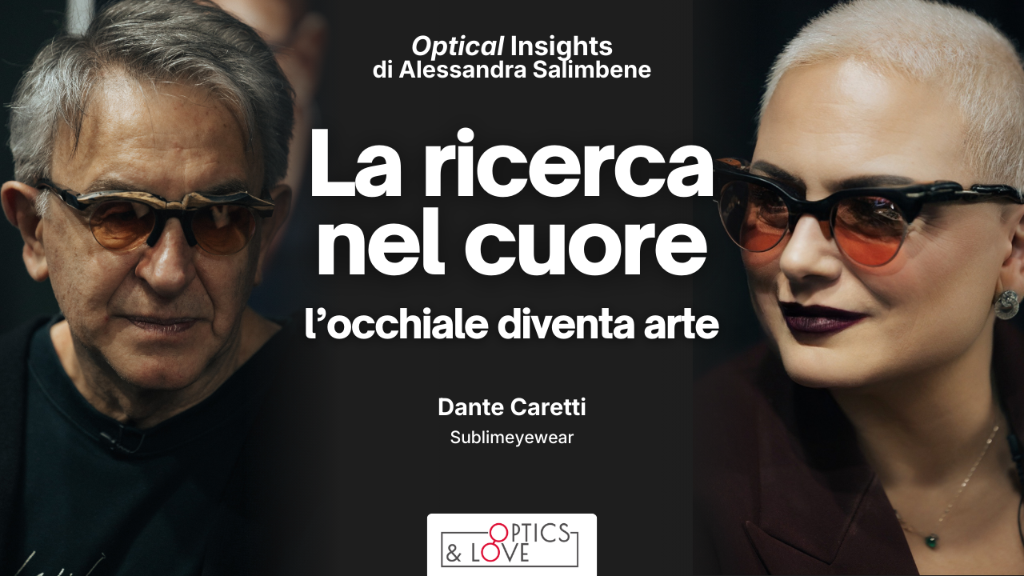
I have been attending MIDO since I was a child. For those who work in optics, it is not just a trade fair but a kind of cultural thermometer: it tells you where we are heading, what we are becoming, what we risk losing.
Dante Caretti and I have known each other for many years. We have navigated very different seasons of the industry together: the enthusiasm for research eyewear when it was still a novelty that many resisted, the phase when it became a trend, the moment when it matured and found its own identity. Every time we sit down to talk, I know the conversation will go far beyond the product.
This year we chose as the title of our interview a phrase that, in my view, is anything but trivial:
"It's not the frame that makes the shop."
Dante says it with his characteristic candour, but behind that phrase lies a very clear premise: it is the entrepreneur who makes the shop. It is their vision, their capacity to propose, their culture that determines the direction.
The misconception of independence
In our industry, independence is still too often discussed as if it were a matter of assortment. People seem to think that replacing some brands with others — perhaps more niche or less widely distributed — is enough to claim an autonomous position.
In reality, independence is an entrepreneurial stance that precedes any product choice.
During the interview, Dante observes that opticians are afraid and "prefer to sell what the market asks for". That phrase struck me because it precisely describes a dynamic I encounter daily in my work: the tendency to flatten out onto explicit demand in order to avoid risk.
The problem is that the moment an entrepreneur limits themselves to responding to requests, they implicitly accept playing by rules set by others. Chains and online platforms are built to intercept and satisfy mass demand; competing on that terrain means entering a logic that does not favour the independent.
Being independent in 2026 means taking responsibility for proposing — even when proposing requires explaining, arguing, accompanying.
Research between maturity and responsibility
Research eyewear has had a complex journey. It was avant-garde, then fashion, then a recognisable language. Today we are in a phase I would call maturity, and maturity brings with it a new responsibility.
Dante speaks of artists as "endangered species" that need protecting, because they represent the avant-garde from which the system draws inspiration. He talks about young designers, experimental materials, handcrafted processes, and reminds us that "the avant-garde serves to do research that must then reach the mass market".
I share this vision, but I believe the central point today is a different one: research, to become a strategic lever, must be integrated into a coherent project.
An interesting product, on its own, does not build identity. Without a narrative to contextualise it, without an environment to support it, without a vision that makes it part of something larger, it risks remaining an isolated episode. This is where the figure of the entrepreneur returns to centre stage: not as a mere brand selector, but as an interpreter of a language.
The shop as cultural expression
One of the most powerful moments in the interview is when Dante states: "It's not the frame that develops the shop, it's the owner". I prefer to speak of entrepreneur, because that is where true responsibility lies.
An independent optical practice is not merely a commercial space; it is a cultural project that reflects the choices, taste and leadership capacity of the person running it. Over these months, working between Italy and the United Kingdom, I have observed that the most solid realities are not necessarily those with the most extreme assortments, but those in which there is a recognisable coherence between environment, product offer and the way relationships are built.
Identity does not arise by chance and is not built by accumulation. It is the result of repeated decisions over time, often counterintuitive in relation to immediate demand.
When Dante says that opticians should learn to "build shops" before worrying only about frames, he is invoking precisely this dimension: the shop as a space that speaks, that communicates a vision, that does not merely display merchandise.
Propose, don't chase
There is a moment in the interview when Dante observes that many talk at length about "consultative selling", but then simply give the client what they ask for. It is a contradiction that deserves to be addressed honestly.
Consulting implies taking a position. It means proposing something the client had not yet formulated as a need; it means accepting the risk of suggesting an alternative.
Dante says that "people are like clay" when guided with competence, and that they often appreciate originality more than the optician imagines. It is a provocative image, but it contains a core of truth: the public is willing to listen, provided they find confidence and conviction on the other side.
When an entrepreneur abandons the proposal for fear of losing a sale, they are in fact giving up the opportunity to build a positioning.
Price and intrinsic value
Another significant passage concerns the relationship between price and value. Speaking of handcrafted processes and material research, Dante recalls that "when you spend six or seven hours making a non-industrialised frame, the frame costs". It is a simple observation, but a fundamental one.
In this case, the price is a consequence of a process. It becomes understandable because it can be explained. If instead the perceived value is tied exclusively to a brand or an image, the figure is far more easily compared and contested.
The difference, once again, lies not only in the product, but in the entrepreneur's capacity to explain the meaning of their choices. Without this cultural dimension, even the most interesting offer risks being reduced to a number.
A decision that precedes the assortment
Being independent in 2026 does not mean opposing a system, nor retreating into a self-referential niche. It means defining clearly what role you want to play in your territory and what idea of shop you intend to embody.
The phrase we chose as the title of the interview is not a slogan, but a reminder: identity cannot be bought at a trade fair and cannot be resolved by a product order. It is an entrepreneurial decision that precedes every assortment choice and finds its point of balance in the vision of the person leading the business.
In this sense, independence is not a consequence of the product. It is a conscious choice that the product can make visible — but which is born elsewhere.
If this theme concerns a decision for your optical practice or a company project, the first step is a call: we start from your context.
Book a call