AI, Data and Relationship: The New Balance of Independent Optics
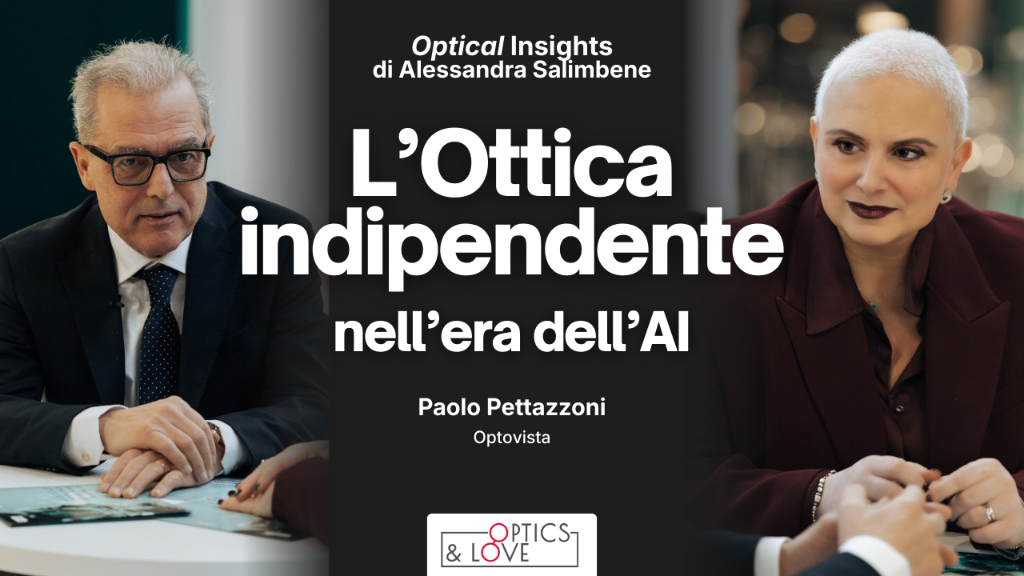
In a conversation with Paolo Pettazzoni, CEO of Optovista at MIDO 2026, a central point emerges: artificial intelligence is not the change — it is one of the tools within a broader transformation. The real strategic challenge is how data, personalization, and human centrality can coexist in a structured way.
In recent months, the optical sector has begun moving within an evident tension: on one hand, price pressure; on the other, technological acceleration.
In my conversation with Paolo Pettazzoni, CEO of Optovista at MIDO 2026, one central point emerged clearly: artificial intelligence is not the change. It is one of the tools within a broader transformation.
The real strategic challenge today is not "using AI." It is understanding how data, personalization, and human centrality can coexist in a structured way.
That is where the future of the independent optician is being decided.
A Polarizing Market
2025 showed clear signals: in the second half of the year, the market slowed down. In a scenario of economic uncertainty, caution becomes collective behavior.
GfK data highlighted a significant dynamic: in the chain channel, the average sell-out price of lenses decreased substantially. A classic lever in a stagnant context: lower prices to sustain volumes.
The independent optician, on the other hand, cannot compete on the same ground. Not due to incapacity, but due to the nature of their own business model.
When the market polarizes, strategies become clear:
- Either you compete on price
- Or you compete on value
And value, today, passes through three pillars.
1. Data: From Administrative Archive to Strategic Lever
The optical sector has always collected data: prescriptions, parameters, purchases, replacement frequency. But for years, data has remained primarily a management tool. Today that is no longer enough.
In an evolved model, data becomes:
- A tool for understanding behavior
- A basis for positioning decisions
- A lever for continuous improvement
The most interesting shift that emerged in the interview concerns the use of AI in generative form: not a static algorithm that applies predefined rules, but a system that modifies itself based on collected feedback.
If the customer returns, if they provide feedback on the visual experience, if the optician collects that information in a structured way, the system evolves. It is not technology as an end in itself. It is method.
The difference is not made by AI. It is made by data culture.
2. Personalization: Not a Slogan, But a Process
"Personalized lens" is an expression the market has used for years. But what does personalization really mean today? It is not just about adapting technical parameters. It is about building a dialogue.
In the interview we talked about how AI can generate dynamic questions based on customer responses. This changes the very nature of the consultation. Personalization becomes an articulated process:
- Guided listening
- Collection of qualitative information
- Interpretation of usage context
- Delivery of a coherent proposal
Technology, in this scenario, does not replace the professional. It supports them. The point is subtle but fundamental: if AI is perceived as automation, it frightens. If it is integrated as a tool to support dialogue, it strengthens the relationship.
And this is where a crucial concept comes in: the sale is no longer linear.
Feedback → Improvement → New Proposal → Evolution
This model creates continuity. And continuity creates loyalty.
3. Human Centrality: The True Competitive Advantage
When the market contracts and competition shifts to price, the independent optician has only one viable path: strengthening their relational identity. But "relationship" does not mean friendliness. It means structure:
- An updated CRM
- A follow-up call
- A feedback request
- Genuine attention to the usage experience
In the interview we touched on a decisive point: the reluctance to call customers back for fear of receiving negative feedback. It is a cultural issue.
Uncollected negative feedback remains negative. Collected feedback becomes improvement.
Human centrality is not in opposition to technology. It is what gives technology meaning.
- Without relationship, AI is automation
- Without data, relationship is fragile intuition
- Without strategic vision, data is just numbers
The competitive advantage of the independent optician is not size. It is the depth of the relationship.
The Point of Balance
The future of optics is not played against artificial intelligence. It is played in the ability to integrate three dimensions:
- Structured data
- Real personalization
- Human centrality
It is not about becoming technological. It is about becoming aware. Market polarization is not a threat if you understand your own positioning. Chains can work on scale. The independent can work on quality.
AI does not replace the optician. It makes the optician who knows how to use it more powerful.
If you want to delve deeper into these topics, you can watch the full interview with Paolo Pettazzoni recorded at MIDO 2026, where we analyze in detail the evolution of the market, the role of technology and the prospects for independent optics.
Because change is not an event. It is a process. And today, more than ever, a clear-eyed perspective is needed to navigate it.
If this theme concerns a decision for your optical practice or a company project, the first step is a call: we start from your context.
Book a call