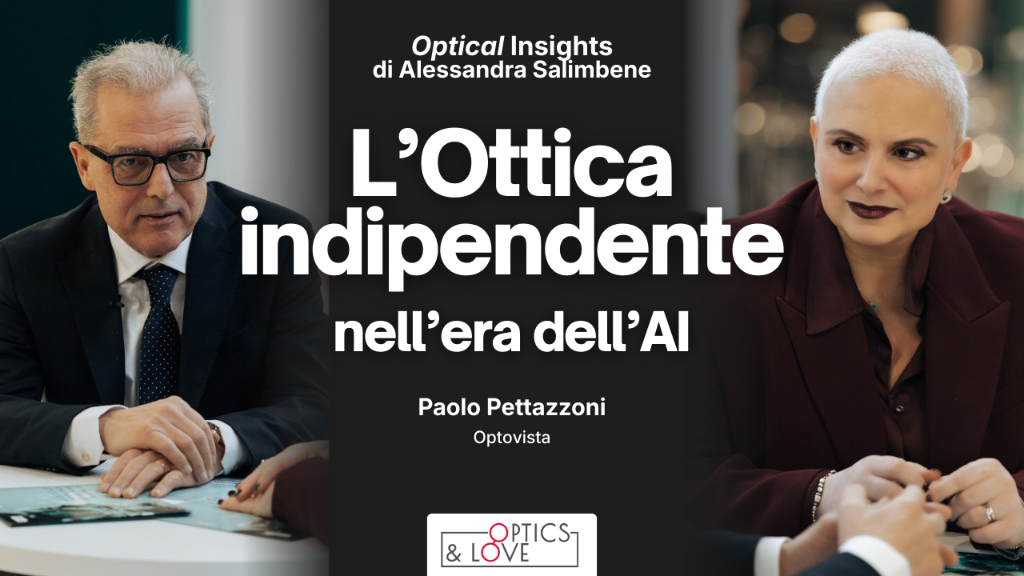
Smart but Independent: design becomes smart and expands the functions of eyewear
At MIDO 2026, Alessandra Salimbene meets Francesco Caretti of Sublimeyewear to discuss Even Realities: smart glasses with augmented reality and integrated AI. An analysis of how design, accessibility and technology converge — and what this means for the independent optician.
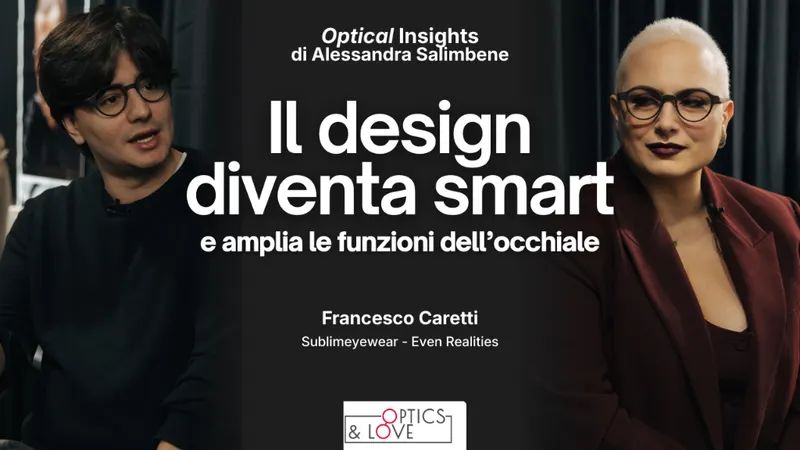
Optical Insights by Alessandra Salimbene
When glasses become smart, the question is not whether the sector will change. It's who will lead the change.
At MIDO 2026, I sat down with Francesco Caretti. Son of Dante, raised in one of the most coherent and rigorous contexts of Italian independent eyewear. And he talked to me about artificial intelligence.
It wasn't actually a surprise. For a few years I had been seeing this conversation approaching — I could feel it in the air at trade fairs, in comments at the margins of presentations, in the increasingly concrete curiosity of the opticians I meet in my work. What struck me this time was the way Francesco framed the issue. Not as a choice between opposite worlds, but as a terrain on which eyewear — real eyewear, the kind that is designed and worn — can still play a central role.
The product we discussed is called Even Realities, distributed in Italy by Sublimeyewear. Smart glasses with augmented reality and integrated artificial intelligence. Built by a team of engineers. Sold, increasingly, in the best Italian independent opticians.
The wearable future is already in-store
In recent years, the narrative around wearable devices has oscillated between the enthusiasm of tech evangelists and the skepticism of those who work in the field. Google Glass, the commercial failure of early headsets, the long season of smartwatches perceived as second-rate accessories. It seemed as if the human body resisted digital colonization.
Then came Meta Ray-Ban. And things started moving.
Not because the technology had become miraculous, but because someone had finally understood that form matters. That a wearable device must want to be worn. That the boundary between a technological object and a style object is not an aesthetic detail: it is the very condition of its success.
Eyeglasses are at the center of this transformation. They are, for practical reasons — they sit on the face, close to the eyes, close to the ears, in a privileged position to collect and return information. And they are for cultural reasons, which in our sector we know well: eyewear has always been an object of identity, not just function.
Design as a condition, not an optional
Francesco says it clearly during the interview: "Glasses are the first thing others see about us when they meet us". It's a simple sentence, but it has considerable specific gravity in a discussion about technology.
Because it speaks of an awareness that is by no means obvious in the tech world: wearable technology cannot afford to ignore aesthetics. Not as a concession to the market, but as a structural requirement. A product that one doesn't want to wear doesn't get worn. And a product that doesn't get worn doesn't exist.
The Even Realities project was born from a team with a strongly technological background, but has incorporated design as a primary, not decorative, dimension. This, in my opinion, is the difference from many previous attempts: there was no attempt to add technology to an existing object, nor to convince people to wear an electronic device. The work was done on the eyeglass as such — in its shape, its balance, its relationship with the face.
It is not yet the artisanal research eyeglass. But it is a product that respects the object.
An accessibility we hadn't considered
There is a moment in the interview that stopped me. Francesco tells the story of a deaf girl who was one of the first to try these glasses — and who kept coming back to the store to give feedback, because those glasses provided her with real-time subtitles of what was being said around her.
It's a powerful image. Not because the technology is entirely new — there are already applications that transcribe audio into text — but because it makes it wearable, discreet, integrated into daily life without the stigma of a special device.
Added to this is instant translation: at trade fairs, while traveling, in an international professional context. The ability to take visual notes, to navigate without looking down at one's phone. Features that seem convenient but which, in certain contexts, substantially change the quality of the experience.
This dimension — the eyeglass as a tool of accessibility and autonomy — is still little explored in our sector. And it is, in my opinion, one of the strongest arguments for anyone wanting to position this type of product seriously.
The independent optician as protagonist
The question that interests me most, however, is another: what does all this mean for those who run an independent optician's?
The most comfortable answer would be to wait. To observe how the market moves, wait for the product to consolidate, enter when the risk has reduced. It's an understandable logic, but it's exactly the logic that over time has eroded the independent's space in favor of chains and online platforms.
The technological product creates something in-store that the online channel cannot easily replicate: a moment of wonder. As Francesco tells it, there is a phase where you let the customer try on the glasses, they remain "stunned for a moment," and from there a new conversation begins. New in the literal sense: it's not the conversation about the frame, it's not the one about the progressive lens. It's a conversation about how technology can improve their day.
This opens up new customers — including those who don't wear prescription glasses, because the product also works without prescription lenses. And it builds a new type of relationship with regular customers, who return to the store with a different question.
Those who know how to seize this opportunity now build a positioning. Those who wait will find themselves chasing.
Coexistence as a conscious choice
Francesco is very direct on one point: he wouldn't want to live in a world where there's "only one side or the other." He is convinced — and so am I — that smart eyewear and design eyewear are not mutually exclusive, but complementary. That the same customer can wear both, in different moments and contexts.
This coexistence, however, is not automatic. It requires a choice on the part of those who run a store: deciding to carry both, knowing how to present both, building an offer that makes sense as a whole.
The alternative — sticking only to tradition out of fear of technology, or embracing technology while forgetting the value of design — produces in both cases a loss. Of positioning, of clientele, of identity.
Artisanal research eyewear and smart eyewear are not competing for the same customer, at the same moment. They are two responses to different needs, which can coexist in the same space — if whoever manages that space has the vision to keep them together.
Watch the full interview
If this theme concerns a decision for your optical practice or a company project, the first step is a call: we start from your context.
Book a call