When rules generate genius: Adam Mugavero and sculpture eyewear
Adam Mugavero makes glasses the way one makes a sculpture. At MIDO 2026, Alessandra Salimbene meets him and discovers how function, and not in spite of function, generated something truly brilliant.
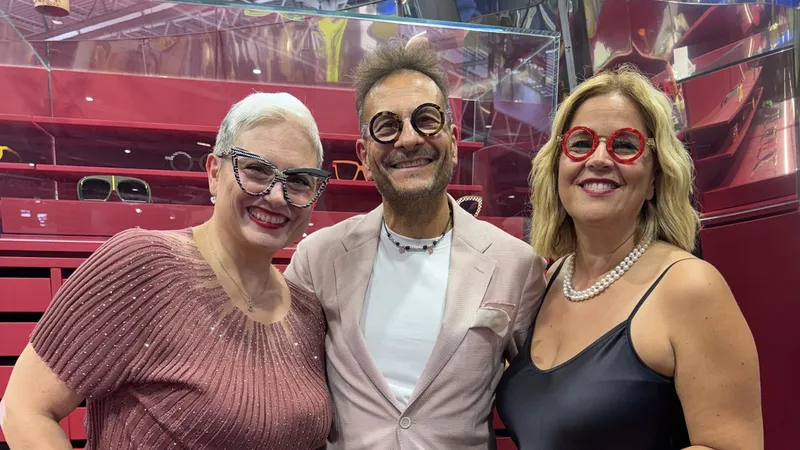
At MIDO 2026 I stop in front of a display and go no further. Adam Mugavero’s glasses are the kind that stop you: not because you expected to find them there, but because you cannot immediately understand what you are looking at. They look carved. They look painted. They look, first of all, like objects.
Adam comes from New York. His background is sculpture, then music. Eyewear arrived by chance, the way things arrive that later become everything: he broke a pair of glasses and put them back together with his hands. From that moment he started building new ones. First as an exercise, then as a language.
When we sit down to talk, I immediately understand that I do not have a designer in the conventional sense in front of me. I have someone who found in eyewear a way to communicate, exactly as he had done with music. Only now he works with his hands. And with wood.
The problem of the material
The first thing Adam talks about is not aesthetics. It is the technical problem. Wood is not a flexible material. It does not bend, it does not adapt, it does not tolerate imprecision. Bringing it into the world of optics, where symmetry is a functional matter, not only a visual one, where the hinge has to open and close thousands of times, where the weight on the nose and the ears changes everything, required real solutions. It required working with opticians, studying different joints, rethinking the closures that in traditional wood are made by snap-fit.
This part of the conversation interests me particularly, because it tells something that in the world of handmade eyewear is too often taken for granted: beauty is not enough. An object that does not work is not a pair of glasses. It is a sculpture. And Adam, who comes from sculpture, knows it better than anyone. The difference, he tells me, is exactly this. And having understood it first-hand, through trial, error and dialogue with people who really know optics, is what made his work something more than an artistic exercise.
Painting with wood
Once function was solved, Adam devoted himself to language. He uses ebony as a base, for its density, its colour, the way it behaves under the hands. Then he inlays it with other materials, other woods, other colours. The result resembles a painting, but it is three-dimensional and wearable. Each piece comes from a different combination, and each combination takes time: Adam makes them one by one, alone.
When I tell him he seems to paint with wood, he nods. It is a definition he feels is his. The material has its colours, its grain, its moods, and he uses them as a painter uses pigment, but with the added constraint of shape, weight, fit on someone’s face. It is this double level, artistic and functional together, that makes his glasses hard to place in the usual categories. They are not fashion accessories. They are not visual prostheses. They are objects in the full sense of the word.
When creativity has rules
There is a sentence Adam says almost in passing, and that instead deserves a pause.
When creativity has rules, that is where something truly brilliant can be born.
He says it thinking of function, of the fact that glasses have to stay on the head, protect the eyes, respect symmetry. But it is a reflection that applies more widely. It applies to anyone working in a field where creative freedom meets real constraints: materials, budget, market, customer. In the optical industry this tension is daily. The craftsman who wants to experiment collides with the needs of the optician who has to sell. The designer with a vision has to reckon with what the customer is willing to understand. Adam says it is exactly in this space, at the point of friction between idea and constraint, that the most interesting solutions emerge. It is not a romantic stance on creative suffering. It is a technical observation: the problem forces you to find roads you would not have looked for without it.
Eyewear as a signature
Adam has a clear conviction about what a pair of glasses should be: a signature. Not in the sense of a logo or a recognisable brand, but in the sense of something that tells who wears it. "Glasses should be something like a signature of your personality and your style", he says. For him the signature is not a graphic element or a trendy material. It is the choice of wearing something made by hand, piece by piece, by someone who put time into it. It is the choice of carrying on your face an object that does not exist exactly the same anywhere else in the world. It is the idea of identity that also runs through the neuroscience series.
His ideal customer, he tells me, is someone who wants to wear their own identity. Someone who appreciates manual work not as a rhetorical value, but as a concrete fact: they know that pair of glasses took hours, that no identical one exists, that buying it means entering a relationship with whoever made it. This customer exists. They are looking. And often they do not know where to find what they are looking for, because what they are looking for is not on any ordinary shelf. For the independent optician it is the same lesson as The product is content too: the product sells with its story.
What stays
When we say goodbye, I wish him success in Italy. He replies that he already has it, and he means exactly this: the interview, the meeting, the fact of being there talking with me. It is a gesture of great kindness, said with the simplicity of someone who has no need to show off. It struck me, because it came from someone who would have every reason to be sure of himself, and instead chose gratitude.
This is what stays with me from this conversation: not the beauty of the glasses, which is evident and needs no telling. What stays is the idea that the boundary between art and craft, between function and expression, between object and signature, is much thinner than the industry tends to believe. And that whoever manages to stand exactly on that boundary, without falling on either side, produces something no algorithm and no distribution chain will ever be able to replicate.
In the video on this page you will find the full interview with Adam Mugavero. From the same edition of MIDO also come the conversations with Dante Caretti and Francesco Caretti; the theme is branding for the optical practice.
If this theme concerns a decision for your optical practice or a company project, the first step is a call: we start from your context.
Book a call