Passing the soul of a frame to someone else: Alain Mikli at Silmo
At Silmo 2026 Alain Mikli talks about the legacy he wants to leave, and why a group like Luxottica chose to invest in skill. A commentary by Alessandra Salimbene.
Alain Mikli at Silmo: one man's legacy and one group's choice
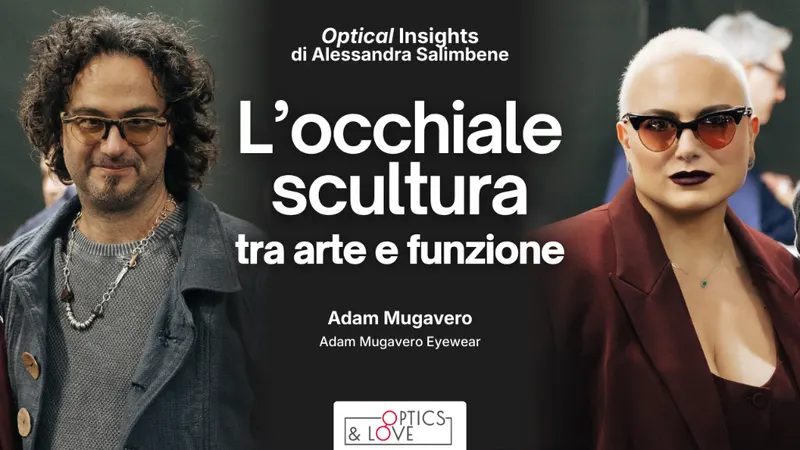
Every time I meet Alain Mikli it is a moment in my life. I say so at the start of the video, before the first question, and I repeat it here because without that premise the rest would be a report, and I would like it to read more like a testimony. At Silmo we met for the first time in Paris, in his city, in a small space that carries his name, and we greeted each other the way people do when they are truly glad to meet again.
A story almost fifty years long
Alain Mikli, born Alain Miklitarian, opened his design studio in Paris in 1978 and built from it one of the most recognisable names in designer eyewear: frames nobody mistook for anyone else's, collaborations such as the one with Philippe Starck on the Starck Eyes line, and a company, Alain Mikli International, that grew around his name and his way of seeing. In 2012 the Luxottica group took over Alain Mikli International.
The sale carried a non-compete clause, and for Alain a long pause began: for several years he could not use his own name on eyewear. He did not stop altogether and kept working under his full name, Alain Miklitarian, but the collection that bore his name went on without him. Then Luxottica called him back and, under a new agreement, Alain returned to carry the Mikli collection forward, the one he now leads again from inside the group. About three years have passed since his return.
A man telling his story
He told me that at his age he never thought he would spend four days at an optical fair, and that he did it to take responsibility for working inside a company he describes as incredible in size, in variety and in complexity. He was happy to see opticians he has known for years and to meet new ones, from different generations, and he told me about the very positive comments he had received over those days.
Then I reminded him of something he had said to me before we began: that he was there not only for the collection and the design, but to pass his legacy on to a new generation. The interview changed pace. He said that bringing the Mikli business back to a high level is part of the deal but is not the deal, and that the real deal is to pass on his passion and his skills: the technique with which a frame is produced and the way it is conceived. He added, with a simplicity that struck me, that time runs very fast and that he will not be there forever. His passion, he explained, is making small quantities, almost unique pieces, for one customer at a time. In the same company there are people whose task is the opposite, getting millions of pairs of glasses to market, and he accepts that he stands on the other side while sharing with his colleagues the same wish to leave something that serves the future.
At that point it was he who said thank you. He thanked Francesco Milleri, who in his words has a clear vision and understood that this is not only a question of design and not only a question of name, but of skills, of experience, of a passion to be shared with technicians, with designers and, slowly, with those who work in marketing, communication and sales. Listening to him I thought how rare it is to hear a designer say that the most important part of his work is the part a collection does not show.
What I think of Luxottica
I want to say this plainly, because looking from the outside it was not a given. A group like Luxottica, which at first sight might seem to have nothing to learn from anyone, has chosen, on the decision of its leadership, to invest in an asset that does not appear on a balance sheet: skill, storytelling, the experience of a person who can walk into the plants, among the new machines and the workers still to be trained that Mikli talks about, and show with his own hands how the soul of a frame is passed on. That is how I picture it, and it moves me more than I expected.
Luxottica has a long history of acquisitions and, in my view, has almost always followed an understandable industrial logic: bringing the brands that join the group into shared processes, ranges and channels, aligning them with the rest. It is a logic that works on volume and it has had a price that anyone working on the retail side of the counter knows well, because many of those brands lost part of their appeal and of the traits that made them distinctive, sacrificed to mass production. This is not a judgement on people; it is an observation built over thirty years of working with opticians. That is why the choice Mikli describes looks to me, with the caution of someone watching from outside, like a step forward: treating knowledge as an asset to protect and hand over, rather than as a cost to absorb. He himself says it is a real strategy of the company, still understood by few because it is a big change, and that building skills takes many years. I take that as an honesty that makes me trust it more.
Character, for the few and for each one
When Alain says he wants to help each customer have their own personality and not look like somebody else, I think back to what he had already told me in the interviews I did with him in the past. The role of the optician, he used to say, is to build the architecture of the face, choosing glasses that improve it and that are in harmony with it, so as to form a single whole with the person's face and personality. It is the same idea, said then from the optician's side and today from the product's side, and it is the idea of character I have worked on for years with independent opticians.
Mikli is explicit that his is not a product for everyone. He says it serves twenty percent of the market, or less, and that this is enough, because if the whole market goes in one direction the business falls. For an independent optician the lesson is uncomfortable: a product made for a few sells only if you know who those few are. Mikli says it from his side: pushing a product without talking to the optician, without understanding who they are and what they need, is for him a disaster. When I ask an owner what sets them apart, nine times out of ten I get a list of brands, and a brand made for twenty percent of the market, displayed like all the others, does not find its twenty percent. A product like this is not sold with a discount; it is sold by improving the solution the customer takes home. For now his work shows mostly in acetate; on metal he says he is working on it and that it will take time.
A conversation that stays open
We could have talked for hours, and in a way we have been doing so for years: our conversation has been open since the Covid years and has never really had an end. We agreed to meet at Mido to pick it up again, with another collection and another way of presenting it, and I think we will resume it even sooner, at a distance.
💬 A question for you: in your store, who holds knowledge that risks leaving with them, and what are you doing so that it passes to someone else?
If this theme concerns a decision for your optical practice or a company project, the first step is a call: we start from your context.
Book a call