The voice comes before the channel
For an independent optical practice, identity, audience and an original story matter more than the platform you choose. The 2026 social playbook from Optics & Love.

The 2026 social playbook for the independent optical practice.
The question I get asked most often is always about the medium: is it worth opening TikTok? Does Instagram still work? Is a reel better than a carousel? It is a legitimate question, but asked at the wrong point in the chain, because it comes before the three things that should precede it: who you are, why a customer should choose you, who you are talking to. A practice that has no clear answer to these three can be present on every platform in existence and remain, everywhere, indistinguishable.
2026 does not reward those who are present on more channels. It rewards those who have something recognisable to say and know who they want to say it to. Everything else, the choice of platform, the format, the frequency, comes afterwards, and is a consequence of those first answers, not an independent starting point.
Who you are, and why a customer should choose you
The first two questions are linked but not the same, and they should be kept apart. The first is about you: what your practice stands for, what idea of care, of competence, of relationship with whoever walks in. It is work done upstream, in the practice, long before opening an app, and no channel can do it for you.
The second turns the point of view around and places it on the customer: why they should choose you and not the optician three hundred metres away. It is the question the person really asks themselves, and when I put it to an owner, nine times out of ten I get a list of brands instead. But brands are not a positioning: the practice next door has them too. Differentiation is not what you sell, it is the reason someone should drive half an hour further to come to you instead of buying online. If you cannot say it in one sentence, social media cannot build it: it can amplify a positioning, not invent one.
Social media works like an amplifier: it gives back, enlarged, whatever it finds. A sharp identity it carries far; a blurred identity it distributes blurred, at scale.
Recognisability, the first of the goals, does not come from posting consistently, as people tend to believe, but from this clarity upstream. An optician who has worked on who they are and what makes them different posts less and is remembered more. One who has not posts every day and remains a backdrop. This is the work of branding for the optical practice.
Who you talk to
The third question moves the focus again: not who you are, not why they should choose you, but who the person is that all this is addressed to. And here the most common mistake takes the shape of generosity: wanting to talk to everyone who wears glasses, which amounts to talking to no one in particular. A defined audience does not narrow the market, it brings it into focus: it decides the register you write in, the examples you choose, the kind of story you build and, only at the end, the channel it makes most sense to build it on.
The parent choosing a child’s first glasses, the presbyope who refuses the idea of getting older, the customer who wants a frame as an object of style and not as a medical device: these are three different people, and content designed for all three together does not really touch any of them. Knowing who you talk to is what lets you say something specific instead of something generic, and it is specificity, not volume, that creates a relationship. I also discuss this in Communication in optical retail.
An original story beats a trend
There is a quick way to tell whether a social media choice is bringing you closer to your goal or further from it: ask yourself whether you are doing it because it is yours or because everyone is doing it. A trend, the sound of the moment, the format going round, the viral challenge, has real appeal, because it promises immediate visibility at low effort. But it has a cost that only shows later: if you do exactly what everyone does, the best result you can hope for is looking like everyone. Fashion is borrowed by definition, and what is borrowed does not build recognisability: it consumes it.
An original story grows in the opposite direction. It starts more slowly, it does not give you the peak of the trend, it requires knowing who you are and who is listening, the earlier answers. In return it settles: every piece of content adds a brick to the same building instead of chasing the next wave. This is where charisma lives, which is not a stage gift but a consistent presence, recognisable even when you take the logo away. Following trends and building charisma are two opposite directions: the first makes you look like the moment, the second makes you look like yourself.
This does not mean ignoring what happens on the platforms. It means passing through a trend with your own voice, when it helps, instead of disappearing inside it. The difference between using a trend and being used by a trend is all here: in the first case you stay recognisable, in the second you become interchangeable.
And only now, the channels
When these questions have an answer, the choice of medium makes sense again and becomes what it really is: a decision of function, not of identity. Each channel does something different.
- TikTok is the discovery engine, the only place where a small account reaches people who do not know it without paying, and where raw, true content beats polished content.
- Instagram has stopped being that engine and today works on the relationship with those who already follow you.
- Pinterest captures intent, the person already looking for a frame for a face or an occasion.
- Facebook holds the territory, the local, mature audience that is the real catchment of a physical practice.
- YouTube builds authority that lasts, the video found for years instead of two days.
They are tools in the service of a story, not the story itself. An optician who knows who they are and who they talk to can choose two of these channels and run them consistently. One who does not will open five and fill them with noise, confusing presence with recognisability.
Being found by AI too, and why text matters
There is a second way of being found that did not exist until recently, and it should be kept separate from the first. Search done by people, which is moving to social media, is one thing; search done on their behalf by an assistant is another. More and more often nobody scrolls through a list of results: they ask ChatGPT, Perplexity or Google’s AI answers a question, and they receive a text already summarised, often without clicking on anything. For an optical practice this means that at some point it will be a model, not a person, deciding whether your name appears in the answer to "where do I buy progressive lenses in [town]".
A distinction is needed here, because it is easy to get it wrong: AI does not draw equally from every platform, and a viral TikTok video does not get you into a ChatGPT answer. What counts far more than view counts is what is written about you, and consistent: the website, the reviews, the listings, the descriptions. It is not "post more videos", it is "be legible, and well written, everywhere".
And this is why text matters again, after years in which everything pushed towards video and images. For a person, video comes first, because it stops the scroll and creates the emotion. For a machine it is almost the reverse: a reel, for a model, is above all its caption, its on-screen text and its subtitles; a photo is its description. If under a good video there is a three-word caption and an emoji, for the AI that content is almost mute: perfect for the eyes, invisible to anyone who only reads words. Taking care of the text is not a detail to tidy up after editing the video: it is what makes it legible, to a person and an algorithm together, what you talk about and who you are. A clear identity, put into clear words, is the only version of you that a machine can repeat without distorting it.
Why I praise TikTok but it is not one of my channels
I say it openly, because it looks like a contradiction and it is not. I consider TikTok the channel with the most room for an optical practice, and at the same time I have not put it in my own strategy. The two things go together precisely for the reason this whole article is about.
TikTok is a discovery engine aimed at a broad and mostly young audience. It is exactly what an optical practice needs, living as it does on the people in its area to be reached, many of whom now search right there. Google itself recognised this as early as 2022: according to its internal studies, almost 40% of younger people, when looking for a place to eat, go to TikTok or Instagram instead of Maps or the search engine. The figure was about restaurants, but the behaviour did not stop there. I, however, do not talk to end consumers. Optics & Love addresses owners of optical practices and companies in the sector: a narrow, professional audience that makes considered decisions and that I find on LinkedIn, on YouTube, in the newsletter, where an argument has the space to be read and not only seen scrolling by.
The same channel is right for my clients and wrong for me, and the reason is precisely who I am and who I talk to. Opening TikTok because "it works", without its function serving my audience, would be the mistake this article invites you to avoid: choosing the tool before the question. I would rather stay consistent with the method I propose than be present on one more platform.
What the goal really is
It is worth saying explicitly, because it is the first thing that gets lost behind the metrics. Social media, for an optical practice, serves four purposes, and it helps to keep them in this order: to become recognisable, to create and feed a relationship, to convey value, to express charisma. Views are not on this list, and not out of snobbery towards numbers: simply, a video seen by ten thousand people who forget who you are a second later is worth less than one seen by a hundred who recognise you the next time.
Recognisability is being picked out among those who sell the same product. Relationship is the trust that precedes the purchase, and in a sector where the customer entrusts you with something they will wear on their face every day, that trust is no detail. Value is giving something useful before asking for something in return. Charisma is the part no algorithm distributes, and it remains the only real reason a person chooses you over a lower price.
The next time you wonder whether to open a channel, try answering another question first: if you removed your name and your logo from what you post, would anyone still understand it is you? If the answer is no, the problem is not the channel.
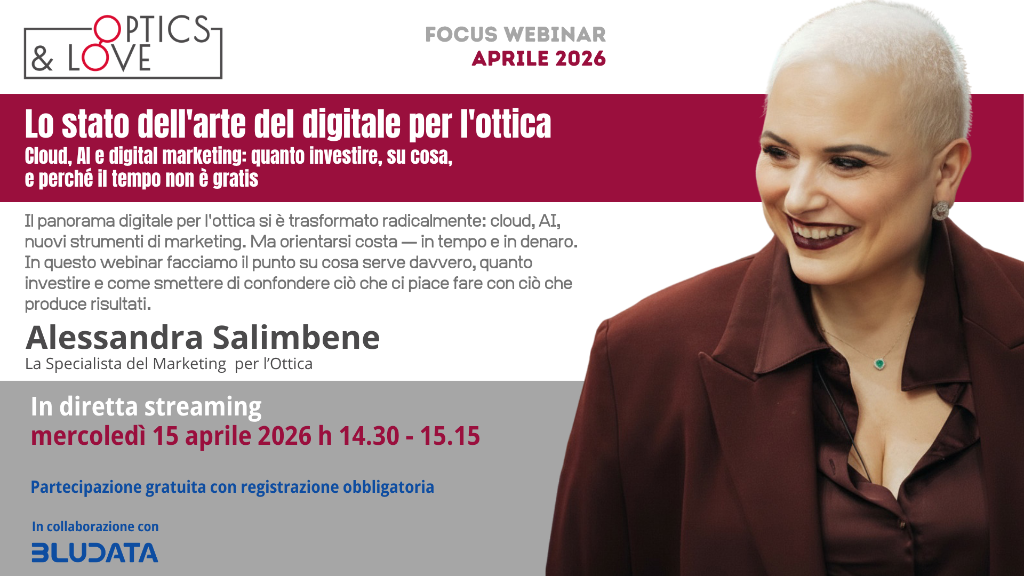
The positioning from which these three answers start is the work of Trade Up and, for the digital side, Trade Up Online in Italy, and of The Charismatic Practice elsewhere, within the theme of digital marketing for optics. I lined up the tools in the webinar The state of the art of digital for optics.
If this theme concerns a decision for your optical practice or a company project, the first step is a call: we start from your context.
Book a call