
The method
A map for reading the optical practice, a method for changing it.
Every Optics & Love project uses the same tools: the Charismatic Method to connect professional identity, strategy and action; the Optical Retail Marketing Wheel to read the areas of the optical practice in a coordinated way; Eyemage for consultative selling. They were born in the work with optical practices and in Alessandra Salimbene’s books.

Identity, strategy, action
An optical practice reflects the choices of the person leading it: whom to address, which services to offer, how to build the range and what kind of relationship to develop with customers. The Charismatic Method connects these decisions in a path that starts from professional identity, defines the strategy and arrives at the operating plan.
Thinking: the role of the entrepreneur and the criteria for guiding choices. Strategy: value proposition, the relationship between services and products, positioning. Action: the areas of work organised by the Wheel.
The ten connected areas of the optical practice
The Optical Retail Marketing Wheel was created in 2017 as the evolution of the 2009 Retail Marketing Puzzle, to give proper weight to IT and digital aspects. It is the foundation of the Charismatic Method and the guide to putting it into practice: after the thinking and strategy phases, the Wheel is the action phase.
It organises the optical practice’s marketing mix into ten areas of activity, connected like the spokes of a wheel: the path starts from strategic planning and ends with relational capacity, the synthesis of all the work. Each area is handled with what emerged from thinking and strategy in mind: everything stays connected.
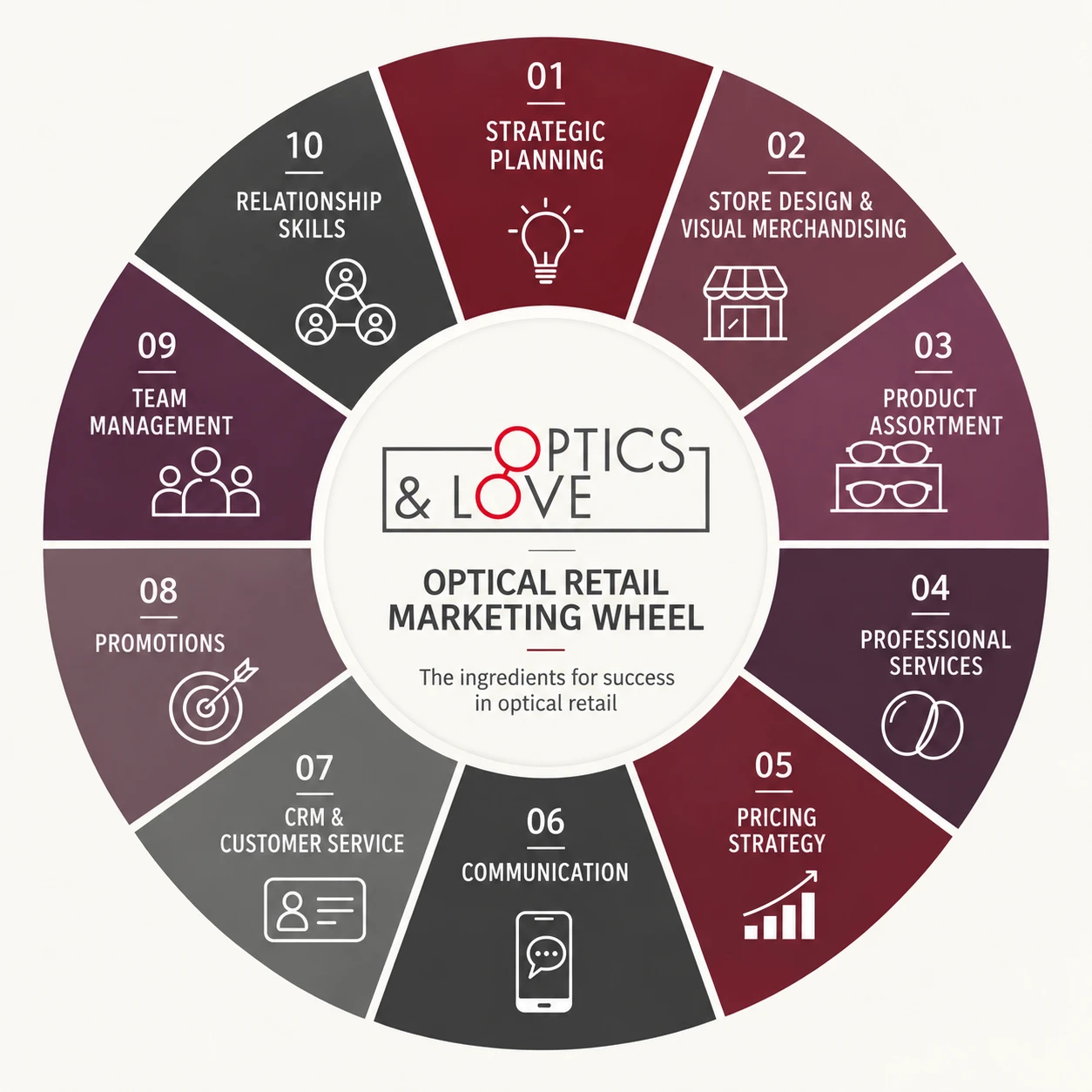
- 01Strategic planningTurns thinking and strategy into an agenda: short- and medium-term objectives, the year’s activities, what is postponed and the indicators used to check progress. A shared calendar with monthly themes, promotions, events and training guides the whole year.
- 02Store design and visual merchandisingThe store is a marketing and communication tool: structure, atmosphere and product display welcome the customer, influence emotions and buying behaviour and communicate the practice’s identity against competitors.
- 03Assortment and category managementThe assortment is managed in two dimensions: the qualitative one, with categories built on customer needs and consistent with the positioning, without overlaps; and the quantitative one, with quantities, stock and inventory turnover. Data make it possible to buy less and better.
- 04Professional servicesOptics combines technological products and vision-related services, close to health, fashion and technology. Services must be designed, communicated and priced, with the management software as part of the service: measurement history, case history, customer segmentation.
- 05Pricing policiesPrice follows the objectives: profitability, competitive positioning, sales volumes. You can sit above, level with or below competitors, as long as the choice is consistent with the positioning and sustainable. The price the customer is willing to pay defines the value they attach to the product or service.
- 06CommunicationTwo areas: personal communication in the practice, meaning consulting and selling, with the figure of the Super-seller, a professional communicator; and external communication, made of visual identity and coordinated image, content marketing and the practice’s communication ecosystem.
- 07CRM and customer serviceCustomer relationship management aims at a one-to-one relationship: identifying customers with a well-kept database, differentiating them by value and needs, interacting in a personalised way through loyalty programmes and institutional, promotional and relational contacts. Service is the intangible part of the product.
- 08Promotions and advertisingPlanned and scheduled promotions, not blanket discounts: easy to communicate, useful to educate customers towards better or more specialised products, limited in time, managed with the software by segment, margins, stock and results. Advertising is only one of the ways the store speaks to its market.
- 09Team managementFront-line staff are the interface between the store and the market. Training, information about objectives, motivation and monitoring of results make the team able to sell better, build loyalty and collect reliable data.
- 10Relational capacityThe synthesis of the wheel: the practice’s ability to create personal, continuous relationships with its market, to be chosen and to become a point of reference for its community, using digital tools as means rather than ends. It concerns customers, suppliers, staff and the local area.
From the method to daily work
The theme pages
For each theme: a clear definition, Alessandra’s point of view, the services, the magazine content, the book and the frequently asked questions.
The method in the magazine
The whole magazine →

The first step is a call. The strategic check-up is Trade Up.